
Türkiye-based chemicals sourcing, from anywhere in the world
We run the sourcing process for industrial chemicals, plastic and paint raw materials, textile chemicals and fertilisers. A safety data sheet and technical data sheet are shared for every product at the request stage, and packaging, labelling and transport mode are chosen according to the dangerous goods classification. We look at Türkiye first; if the product is not available here, we source it from the world's other production centres we source it.
- Documents requiredSafety data sheet (SDS), technical data sheet (TDS), batch certificate of analysis
- Dangerous goodsUN number, class and packing group; ADR, IMDG and, where needed, IATA compliance
- Import permitsThe destination country's prior authorisation, quota and restriction regime is checked before ordering
- Sourcing geographyTürkiye's petrochemical and chemical industry; the Gulf, Europe and the Far East where needed
What do we source in the chemicals group?
In chemicals, very different purities and concentrations exist under the same name. The headings below are the areas we work in; you can raise a request even if the product you need is not shown.
Basic inorganic chemicals
Caustic soda, soda ash, sulphuric and hydrochloric acid, hydrogen peroxide, sodium bicarbonate.
Basic organic chemicals
Methanol, ethanol, acetone, glycols, glycerine, formaldehyde, acetic acid, phenol.
Plastic raw materials
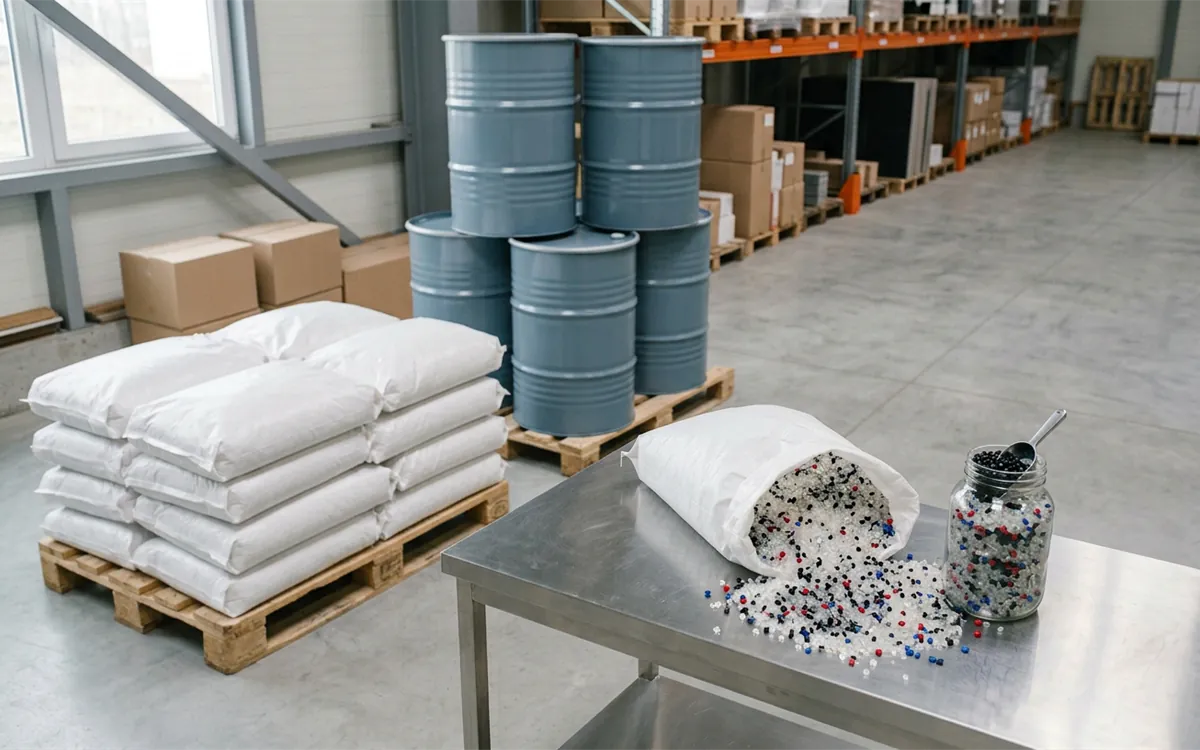
PP, PE (LDPE, HDPE, LLDPE), PVC, PET, PS and ABS granules; masterbatch and fillers.
Paint and coating raw materials
Titanium dioxide, resins, acrylic and alkyd binders, pigments, extenders, driers and additives.
Textile chemicals
Dyestuffs, sizing and finishing chemicals, sequestrants, softeners, print pastes, bleaching agents.
Detergent and cosmetic raw materials
Surfactants (SLES, LABSA), sodium sulphate, enzymes, preservatives, fragrance oils, emulsifiers.
Fertilisers and agricultural chemicals
Urea, ammonium sulphate, DAP, NPK compound fertiliser, potassium sulphate, liquid and foliar fertiliser.
Water and wastewater chemicals
Aluminium sulphate, poly aluminium chloride, flocculants, antiscalants, chlorine and disinfectants.
Construction chemical raw materials
Cellulose ethers, redispersible powders, superplasticisers, calcium formate, curing compounds.
Rubber and polyurethane raw materials
Synthetic rubber, carbon black, polyols, isocyanates, vulcanisation accelerators, plasticisers.
Food and feed additive raw materials
Citric acid, sodium benzoate, phosphate salts, starch derivatives, feed minerals and vitamins.
Laboratory and speciality chemicals
Analytical grade reagents, solvents, standard solutions, catalysts and speciality intermediates.
Which documents are required for chemicals?
In chemicals, documentation is a precondition, not an afterthought. Without classification the transport mode, packaging and cost cannot be determined, so we complete this step before the order is opened.
-
Safety data sheet (SDS / MSDS) The sixteen-section document, in the target market's language. For shipments to Europe, CLP-compliant labelling, hazard statements and pictograms are prepared alongside it.
-
Technical data sheet and batch analysis The technical data sheet shows what the product should be; the batch certificate of analysis shows the actual values of the batch you are receiving. They are two separate documents and we ask for both.
-
Dangerous goods classification The UN number, hazard class and packing group are determined; packaging, labelling, placarding and transport documents are prepared under ADR (road), IMDG (sea) and, where needed, IATA (air) rules.
-
Registration and regulatory compliance REACH registration and any restriction list are checked for exports to Europe. KKDİK applies to imports into Türkiye, and each other market has its own chemical inventory.
-
Packaging conformity certificate UN-approved packaging is used for dangerous goods, and the UN code on the pack must match the packing group. Non-compliant packaging stops the shipment.
-
Origin, movement and import permits Certificate of origin, A.TR for the EU, EUR.1. For many chemicals the destination country requires prior authorisation, a quota or an end-user declaration; we check this before ordering.
Typical working terms
The table below shows customary practice in the chemicals group; the terms applying to each order are set out in the written quotation.
| Packaging | 25 kg bags, big bags (500–1250 kg) or bulk for solids; jerrycans, 200 litre drums, 1000 litre IBCs, flexitanks or ISO tanks for liquids. UN-approved packaging is mandatory for dangerous goods. |
|---|---|
| Loading unit | Palletised, wrapped and labelled loading. Segregation rules apply to dangerous goods: some classes cannot travel in the same container, and the mixed load plan is built accordingly. |
| Delivery terms | EXW, FOB, CFR, CIF and, on request, DAP / DDP. Because some carriers and ports restrict dangerous goods, the routing is settled early. |
| Samples | Samples are sent before the order and approval is taken in writing against the analysis results. A witness sample taken during loading is sealed and retained. |
| Lead time | Short for ex-stock products; longer where production or special packaging is required. Where an import permit is needed, the permit time is added to the lead time and shown separately in the quotation. |
| Quality control | Batch analysis is carried out before loading; on request an independent inspection company takes samples, measures quantity and seals the packaging. The report is sent directly to the buyer. |
Where do we source chemicals from?
In chemicals the source is decided by regulation before price: can the product enter the destination country, with which documents, by which transport mode? Talking about price before those three are settled is pointless.
Petrochemical and chemical industry
Türkiye has a broad industry producing plastic, paint, textile and construction chemical raw materials. Kocaeli, İzmir and Adana are the centres of that production.
What this means in practice is being able, on mid-volume requests, to reach the manufacturer without an intermediary and to split the delivery schedule into instalments.
Classification comes first
A chemical's hazard class determines its packaging, transport mode and freight cost . The same product at a different concentration can fall into a different class.
We therefore establish the classification, safety data sheet and packing group before the order is opened. Misdeclared dangerous goods sit at the port and attract penalties.
Import permits and end users
Many chemicals require prior authorisation, a quota or an end-user declaration in the destination country. Some products are also subject to export controls.
We check this before ordering. The permit process often takes longer than production, so we build it into the lead time from the start to keep the delivery date realistic.
Sourcing from outside Türkiye
The Gulf and North Africa are strong in basic inorganics and fertilisers, Europe in speciality additives and resins, the Far East in intermediates and dyestuffs. For these items we use our global supplier network .
The first step does not change with the origin: classification, safety data sheet and import permit. Price is discussed after those.
Most common questions in chemicals sourcing
How do you work with products classed as dangerous goods?
We work out the classification first: UN number, hazard class and packing group. UN-approved packaging, labelling, transport documents and vehicle placarding are then prepared under ADR, IMDG or IATA rules.
This is done before the order is opened, because the classification can change the transport mode and the cost. The same product at a different concentration can fall into a different class; miss that detail and the shipment sits at the port.
Do you prepare the safety data sheet (SDS)?
The manufacturer prepares it; we check that it is current, in the target market's language and in a compliant format.
CLP-compliant labelling, hazard statements and pictograms come with it for shipments to Europe. An out-of-date SDS, or one in the wrong language, means trouble at customs.
Is an import permit needed in the destination country?
For many chemicals, yes: prior authorisation, a quota, registration or an end-user declaration. Some products may also be subject to export controls.
State the destination country and intended use in your request; we will work out which permit is needed and how long it takes, and add it to the lead time. The permit often takes longer than production.
Do you ship in bulk or packaged?
Both. 25 kg bags, big bags or bulk for solids; jerrycans, 200 litre drums, 1000 litre IBCs, flexitanks or ISO tanks for liquids.
Volume, hazard class and the discharge facilities at destination decide it. The bulk option is often closed off for dangerous goods; we say so up front.
Do you provide a batch certificate of analysis?
We do. The technical data sheet should not be confused with the batch analysis: the data sheet shows what the product should be, the certificate of analysis shows the actual values of the batch you are receiving.
We provide both. On request we have an independent inspection company take and seal samples during loading; in a dispute the witness sample is decisive.
Do you also supply fertilisers?
We do. Urea, ammonium sulphate, DAP, NPK compound fertiliser, potassium sulphate and liquid fertiliser are in scope.
Two things decide it in fertilisers: verifying the nutrient ratios by analysis, and registration with the destination country's agriculture ministry. Some fertiliser types are also subject to security legislation, so classification and permitting run as a separate process.
Do you supply small quantities of samples or laboratory chemicals?
We do, but in this group the shipping cost can exceed the product cost. Moving a small quantity of dangerous goods is disproportionately expensive compared with a large one.
For analytical grade reagents, solvents and standard solutions we work out the packaging and transport rules up front, and show in the quotation whether air or road freight works out better.
Will you source a chemical that is not available in Türkiye?
We do. If the purity or concentration you need is not available in Türkiye, we open the search to the Gulf, Europe, North Africa and the Far East. This happens often in chemicals, where different purities exist under the same name.
The process stays the same: supplier research, sampling and analysis, classification, certification and shipping run from a single point. When the origin changes, the import permit and customs duty change too; we show the comparison in writing in the quotation.