
Türkiye-based construction materials sourcing, from anywhere in the world
We run the sourcing process for hardware, construction chemicals, steel and aluminium profiles, insulation, finishes and door and window systems. On project-based bulk purchases we price from the bill of quantities and split the delivery schedule to match the site calendar. We look at Türkiye first; if the material is not available here, we source it from the world's other production centres we source it.
- Documents requiredCE marking and declaration of performance (DoP), EN standard test report
- Project pricingItem by item from the bill of quantities; the wastage allowance is agreed together
- Delivery scheduleSplit into instalments to match the site calendar, reducing the storage burden
- Sourcing geographyIstanbul, Bursa, Konya, Kayseri, İzmir; the EU and Far East where needed
What do we source in the construction and building group?
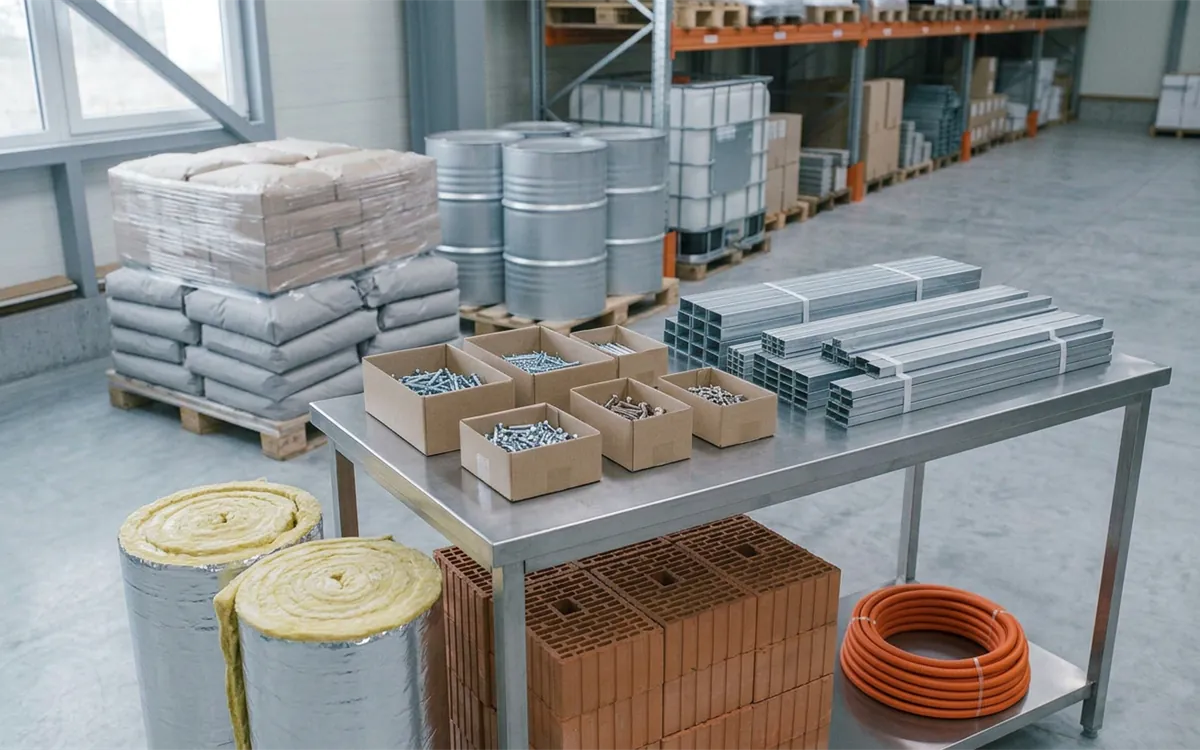
A project's material list spreads across most of these twelve headings at once, and we bring them all into a single quotation. You can also write to us about a material you cannot see listed.
Hardware and fasteners
Screws, bolts, nuts, wall plugs, nails, anchors, hinges, locks, handles, drawer runners.
Hand and power tools
Spanner sets, pliers, screwdrivers, drills, angle grinders, rotary hammers, welding machines, measuring tools.
Construction chemicals
Tile adhesive, grout, waterproofing mortar, levelling screed, repair mortar, chemical anchors.
Insulation materials
EPS and XPS boards, rock wool, glass wool, polyurethane panels, membranes, liquid-applied waterproofing, acoustic insulation.
Steel and metal products
Reinforcing bar, welded mesh, profiles, sheet, tube, galvanised products, wire and mesh systems.
Aluminium systems
Aluminium profiles, facade systems, joinery profiles, composite panels, shutter and blind systems.
Door and window systems
PVC and aluminium joinery, steel doors, internal doors, automatic doors, fire doors and accessories.
Floor and wall finishes
Laminate flooring, LVT and vinyl flooring, carpet, plasterboard, suspended ceilings, decorative panels, paint and plaster.
Plumbing and HVAC materials
PPR and PEX pipe, waste pipe, valves, fittings, combi boilers, radiators, underfloor heating systems.
Electrical materials
Cable, cable trunking, distribution boards, breakers, sockets and switches, light fittings, earthing.
Prefabricated and lightweight structures
Prefabricated building elements, container offices, steel structures, sandwich panels, trapezoidal sheet.
Site equipment and consumables
Scaffolding systems, formwork and props, wheelbarrows, mixers, cutting discs, safety netting, tarpaulins.
Which documents are required for construction materials?
For construction materials, documentation shows that the product can be used on the project . It is the first thing asked for at inspection and approval stage; we establish which your material needs at the request stage.
-
CE marking and declaration of performance (DoP) Mandatory in Europe for products within the construction products regulation. The declaration shows which harmonised standard the product is assessed against and which performance values it meets.
-
EN standard test report Thermal conductivity and fire class for insulation, yield strength and chemical analysis for steel, bond strength for construction chemicals. From an accredited laboratory, matched to the batch or production period.
-
Fire classification certificate A reaction-to-fire class is required for insulation, finishes, cable and panel groups. Materials are not approved without it on public buildings, high-rise and hotel projects.
-
Quality and environmental management systems ISO 9001 and ISO 14001; frequently required on public tenders and large projects. An environmental product declaration is also sought on projects targeting a green building certification.
-
Batch traceability Heat number and mill certificate for steel, production batch and expiry date for construction chemicals. Project inspection can ask which batch a material came from.
-
Origin and movement documents Certificate of origin, A.TR for the EU, EUR.1 for countries with a free trade agreement. Some countries apply safeguard measures and quotas on steel products.
Typical working terms
The table below shows customary practice in the construction and building group; the terms applying to each order are set out in the written quotation.
| Packaging | Hardware boxed and cartoned; construction chemicals palletised in bags, tubs or drums; profiles and pipe strapped in bundles; insulation boards in shrink-wrapped packs. Waterproof protection is essential for material that will stand outdoors on site. |
|---|---|
| Loading unit | Palletised and bundled loading. Steel and construction chemicals are heavy and fill the container by weight; insulation and profiles are light and bulky and fill it by volume. On mixed loads the two are balanced. |
| Delivery terms | EXW, FOB, CFR, CIF and, on request, DAP / DDP. Delivery to site (DAP) is frequently preferred on project work, and responsibility for unloading is stated separately. |
| Samples | Colour and texture samples are approved for visible finishes (coverings, joinery, paint). For technical products, approval is taken on the test report and declaration of performance rather than a sample. |
| Lead time | Short for ex-stock material; longer for made-to-measure joinery, profiles and prefabricated elements. On project work, delivery is split into instalments to match the site calendar. |
| Quality control | Dimensions, quantity, packaging and documentation are checked before loading, and for critical materials the product is matched against the batch certificate. Inspection by an independent company on request. |
Where do we source construction materials from?
In this group the real issue is not price but timing. Waiting on site costs money, and so does storing material that arrives early; we choose the source together with the reliability of the lead time.
A broad manufacturing base
Türkiye makes almost every item in construction materials: from steel to construction chemicals, from joinery to insulation. Istanbul, Bursa, Konya, Kayseri and İzmir are the centres of that production.
What this means in practice is being able to gather most of a project's material list from one geography and to consolidate the shipment.
From bill of quantities to quotation
On project work you usually have a bill of quantities : how much of which material. We price that list item by item.
The wastage allowance is also discussed at this stage. Under-ordering stops the site, over-ordering sits in the warehouse; we set the rate together, by material group.
Delivery to the site calendar
Sending everything in one go is usually wrong: storage space on site is limited and some materials cannot stand outdoors.
We split delivery into instalments matched to the works programme — structural materials first, finishing materials later. That reduces both the storage burden and the risk of damage.
Sourcing from outside Türkiye
Europe can be better for speciality technical systems, branded fittings and certain automation products; the Far East for high volume standard hardware and hand tools. For these items we use our global supplier network .
Whatever the source, the delivery schedule is still tied to the site calendar. We combine items coming from different countries into a single shipping plan .
Most common questions in construction materials sourcing
How do you work on project-based bulk purchases?
We work from the bill of quantities: how much of each material, to which specification. We price the list item by item and also show alternative products with the price difference.
The delivery schedule is split into instalments to match the works programme. Sending everything at once creates storage problems and damage risk on site; structural materials go first, finishing materials later.
Do you supply materials without CE marking and a declaration of performance?
For construction materials going to Europe or any market where CE is mandatory, the documentation is essential; we do not work with uncertified products.
The declaration of performance shows which standard the product meets and to what values, and it is the first document asked for at project inspection. State the destination country and project type in your request and we will work out what each material needs.
Who decides the wastage allowance?
We decide it together. The rate varies by material: high for finishes and joinery that need cutting, low for packaged ready-made products.
It looks like a small item but it matters in the project budget: under-ordering stops the site, over-ordering sits in the warehouse. We review the bill of quantities together and write the rate in.
Can we have items made to measure?
You can. Joinery, aluminium profiles, steel structures, prefabricated elements and kitchen units are all made to measure.
Technical drawings and dimensional approval are taken in writing before production. A dimensional error is irreversible here — a cut profile or finished window cannot be used on another project. That is why we never skip the approval step.
Are there quota or additional duty issues on steel products?
In some countries, yes. Some markets apply safeguard measures, quotas or additional duties on steel, and these change from period to period.
State the destination country in your request; we will check the current position before ordering and show it in the quotation. Miss this and an unexpected duty appears on arrival, upsetting the project's cost calculation.
Do you deliver material directly to site?
We do. Delivery to site (DAP) is frequently preferred on project work, and we handle the customs and inland transport arrangements.
The point to watch is responsibility for unloading: who provides the forklift or crane, and what are the site access hours? We put these in the contract — otherwise the vehicle waits at the site gate.
Which materials need a fire classification certificate?
A reaction-to-fire class is required for insulation materials, facade and interior finishes, sandwich panels, cable and suspended ceiling groups.
Materials are not approved without it on public buildings, high-rise, hotel and hospital projects. If you state the project type in your request, we work out which class each material needs from the outset.
Will you source a construction material that is not available in Türkiye?
We do. Clef Trade is based in Türkiye, but sourcing is not limited to Türkiye; for speciality technical systems, branded fittings or certain automation products we obtain them from European and Far Eastern sources through our global supplier network.
The process stays the same: supplier research, sample or document approval, inspection and shipping run from a single point. When the origin changes, customs duty, quotas and documentation requirements change too; we show the comparison in writing in the quotation.
Construction and building sourcing: tell us what you need, we will find the manufacturer.
Send us the product, target volume and delivery country on whichever channel suits you; we respond within 24 hours with a price range and an estimated lead time.