
Türkiye-based food sourcing, from anywhere in the world
Across pulses, sunflower oil and other vegetable oils, flour and bakery products, nuts, olive oil, canned goods, spices, dairy and frozen food from supplier research to customs clearance we run the sourcing process for you. We look at Türkiye first; if the product is not available here, or the terms do not work, from the world's other production centres we source it.
- Documents requiredISO 22000 / FSSC 22000, HACCP, health certificate; halal certificate on request
- SamplesSamples sent and approved in writing before every order — without exception
- AnalysisAflatoxin, pesticide residue and heavy metal reports on a per-batch basis
- Sourcing geographyTürkiye first; where needed the EU, the Black Sea basin, Asia and South America
What do we source in the food group?
We work across twelve sub-categories. You can raise a request for a product you cannot see on the list — our supplier network is limited neither to this list nor to Türkiye.
Pulses and grains
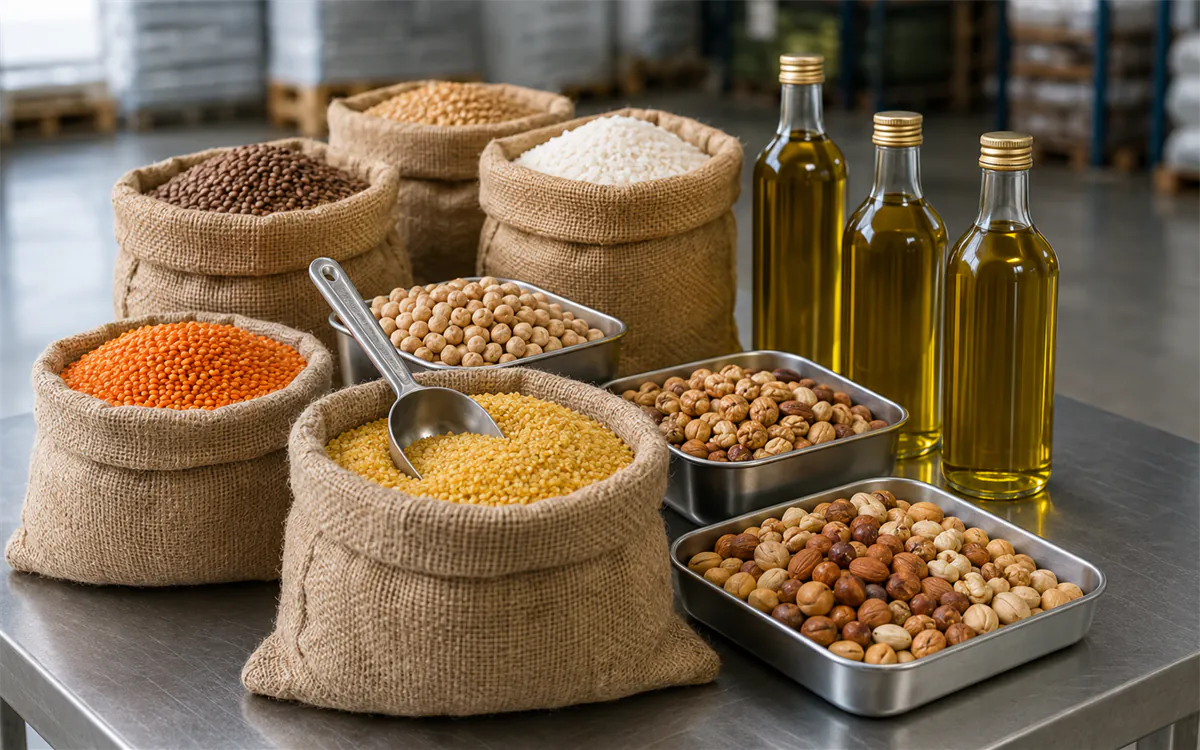
Chickpeas, red · green · yellow lentils, white beans, borlotti beans, black-eyed peas, broad beans, bulgur, rice, maize, wheat, barley, oats, quinoa.
Vegetable oils
Sunflower oil (crude and refined), corn oil, canola · rapeseed oil, soybean oil, cottonseed oil, palm oil, sesame oil, black seed oil, margarine and blended liquid oils.
Olives and olive oil
Extra virgin, virgin, riviera and pomace olive oil; brined black · green and stuffed olives. Bulk, tin, PET or glass packaging.
Flour and bakery products
Wheat flour, wholemeal flour, semolina, corn flour, pasta, vermicelli, couscous, biscuits, crackers, wafers, instant soups and powdered mixes.
Nuts and dried fruit
Hazelnuts, pistachios, almonds, walnuts, peanuts, sunflower and pumpkin seeds; dried apricots, dried figs, raisins, dates, prunes.
Confectionery and cocoa
Icing and granulated sugar, Turkish delight, halva, tahini, grape molasses, chocolate, confectionery, jelly sweets, chewing gum, honey, jam, cocoa and cocoa products.
Canned goods, tomato paste and sauces
Tomato and pepper paste, canned vegetables · fruit, pickles, ketchup, mayonnaise, ready-made sauces, vinegar, products in brine.
Spices and food additives
Chilli and black pepper, cumin, oregano, mint, sumac, fenugreek, spice blends; yeast, baking powder, starch, gelatine, flavourings and food additives.
Beverages
Fruit juice and concentrate, nectar, mineral water, carbonated drinks, black tea, herbal tea, coffee, powdered and ready-to-drink beverages.
Milk and dairy products
White cheese, kashar cheese, tulum cheese, butter, cream, yoghurt, ayran, milk powder and whey powder — with cold chain planning.
Meat, poultry and seafood
Frozen whole chicken and cuts, red meat, processed meat products, frozen fish and seafood, canned tuna. Subject to halal slaughter and a veterinary certificate.
Frozen and ready meals
Frozen vegetables and fruit, potato products, pastry, pizza bases, ready meals and bulk packaging for food service.
Which documents are required in the food trade?
The list of documents varies by product, country of origin and destination country. Those below come up on almost every food shipment; we establish together which ones your batch needs at the request stage.
-
Food safety management system ISO 22000 or FSSC 22000 plus a HACCP plan; BRCGS or IFS if the buyer requires it. This is the first condition we check when selecting a manufacturer.
-
Health and veterinary certificate Plant products need a health certificate; animal products additionally require a veterinary certificate and an approved establishment number.
-
Analysis report Aflatoxin (nuts, dried fruit), pesticide residue, heavy metals, microbiological analysis; free acidity and peroxide value for oils — from an accredited laboratory and matched to the batch number.
-
Halal and kosher certification Frequently requested in Gulf, North African and Southeast Asian markets. On request we direct you to manufacturers certified by an accredited body.
-
Label compliance Target market language, nutrition table, allergen declaration, batch number and best-before date. We check these before printing.
-
Origin and movement documents Certificate of origin, A.TR for the EU, EUR.1 for countries with a free trade agreement; the equivalent document of the relevant country for third-country origin shipments — this is where the customs duty advantage comes from.
Typical working terms
The table below shows customary practice in the food group; the terms applying to each order are set out in the written quotation.
| Packaging | 25 / 50 kg polypropylene sacks or retail packs for pulses and grains; PET bottles, tins, jerrycans, IBCs or flexitanks for vegetable oils; vacuum or modified-atmosphere packs for nuts. |
|---|---|
| Loading unit | Palletised or bulk loading. A 20 ft dry container for heavy products (pulses, flour, canned goods, oil) and 40 ft for bulky ones; a reefer container where cold chain is required. |
| Delivery terms | EXW, FOB, CFR, CIF and, on request, DAP / DDP. We compare which works out cheaper for you based on the destination port. |
| Samples | Samples are sent before the order, approval is taken in writing, and the order is opened against the sample reference. |
| Lead time | Short for ex-stock products; tied to the harvest calendar for items requiring production, special packaging or seasonal supply. Estimated production and loading dates are stated separately in the quotation. |
| Quality control | Batch control is carried out before loading; on request an independent inspection company checks quantity, packaging, labelling and conformity to the sample. |
Where do we source food from?
We look at Türkiye first — for most products price, lead time and certification line up here. When they do not, we widen the search beyond Türkiye.
Depth of production
Türkiye is the world's leading exporter of dried apricots, dried figs and hazelnuts; it has broad production and processing capacity in pulses, flour, pasta, olive oil, sunflower oil and canned goods.
What this means in practice: for the same product we can obtain quotes from more than one manufacturer. That is why we are able to compare price and lead time.
Distance and transit
Sea freight to Europe, the Middle East, North Africa and the Black Sea basin takes a few days; road transport is still viable to many destinations.
A short transit time is a direct cost advantage for short shelf-life products — every day in the cold chain turns into money.
Certification infrastructure
Because many facilities already export to the European Union, it is not difficult to find manufacturers familiar with systems such as ISO 22000, BRCGS and IFS.
The network of accredited bodies for halal certification is well established, and kosher requirements can also be met.
Sourcing from outside Türkiye
If the product is not made in Türkiye, is out of season, or the price is not competitive, we open the search to our global supplier network — the Black Sea basin for grains and oils, Asia for rice, spices and seafood, South America for soy and coffee.
The process does not change: supplier research, sampling, inspection, certification and shipping still run from a single point .
Most common questions in food sourcing
Do you have a minimum order quantity?
We do not set a fixed floor; the minimum quantity depends on the manufacturer and the product. In practice container economics decide it: for heavy products such as pulses, flour, oil and canned goods, the unit cost of freight rises quickly below a full container load. For smaller volumes we also consider LCL shipping or consolidating several products into the same container.
How do you work with sunflower oil and other vegetable oils?
Alongside crude and refined sunflower oil we also work with corn, canola, soybean, cottonseed and palm oil. Packaging options are PET bottles, tins, jerrycans, IBCs and flexitanks for bulk shipment; which one suits depends on the volume and the infrastructure at the destination port.
In this group the analysis report is a subject in its own right: free acidity, peroxide value, moisture and volatile matter figures come with the batch. For bulk shipments we also require a tank cleanliness certificate before loading.
Can you provide halal certification?
We do not issue the certificate — accredited certification bodies do. What we do is, where your request carries a halal condition, restrict supplier selection to facilities holding a valid halal certificate and verify before shipment that its scope genuinely covers your product. A copy of the certificate is shared with the quotation. We follow the same route for kosher requirements.
Do you supply certified organic food?
We do. When an organic request comes in, we restrict supplier selection to facilities holding a certificate recognised by your target market — the EU organic certificate for the European Union, USDA NOP for the United States. We do not issue the certificate; authorised control and certification bodies do.
Two points get missed in this group: the certificate's scope (does it genuinely cover your product) and its validity date. We check both before shipment and share a copy of the certificate with the quotation. Organic products also require separate shipment planning so that they do not mix with conventional goods in transport and storage.
Can we have production under our own brand?
Yes. Private label work is common in the food group, particularly in olive oil, sunflower oil, pulses, pasta, confectionery and tea. In that case label design, packaging material and print approval run as a separate step before production.
We check the target market's labelling rules — nutrition table, allergen declaration, language — before anything goes to print. A labelling error discovered after printing is the most expensive mistake in this group.
How can we order without seeing the product?
Do not. That is exactly why the sampling step exists: a sample is sent from the manufacturer we select, your approval is taken in writing, and the order is opened against the sample reference.
On request we also arrange batch control with an independent inspection company before loading — quantity, packaging, labelling and conformity to the sample are checked, and the report is sent directly to you.
What do you do for products requiring a cold chain?
We write the transport mode and temperature range into the shipping plan from the outset: reefer container or vehicle, temperature logging, pre-cooling before loading. Because the logger data is a document that can be requested on arrival, we add it to the contract.
For short shelf-life products, road or air freight can work out better than sea freight; we show the comparison in the quotation.
Will you source a food product that is not available in Türkiye?
We do. Clef Trade is based in Türkiye, but sourcing is not limited to Türkiye; if the product is not made here, is out of season, or the price is not competitive, we obtain it from other countries through our global supplier network.
The process stays the same: supplier research, sampling, inspection, certification and shipping run from a single point. When the country of origin changes the required documents change too; we tell you this in writing at the request stage.