
Türkiye-based petroleum products sourcing, from anywhere in the world
We run the sourcing process for lubricants, base oils, greases, bitumen, paraffin, solvents and additives. A certificate of analysis is provided with every batch ; products classed as dangerous goods are packed and labelled in line with ADR and IMDG rules. We look at Türkiye first; if the product is not available here, we source it from Gulf, Black Sea basin and European sources we source it.
- Documents requiredCertificate of analysis (COA), safety data sheet (SDS), product specification
- Dangerous goodsADR and IMDG classification, UN number, packing group and labelling
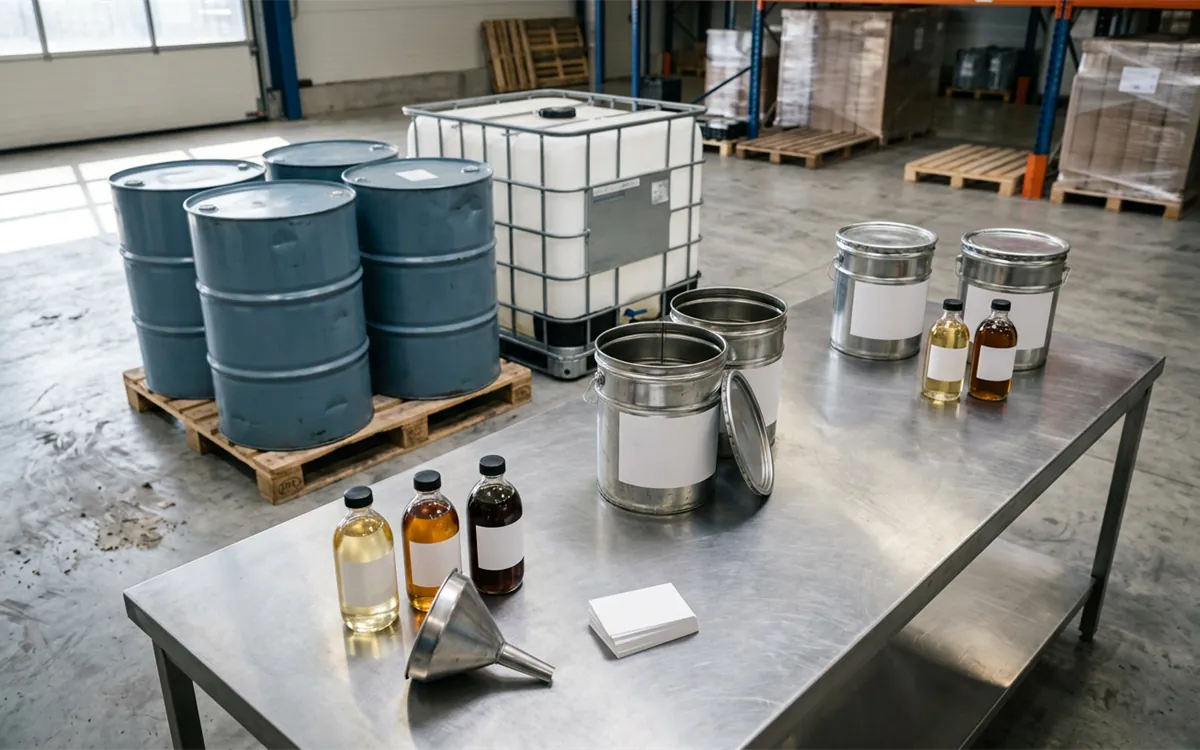
- PackagingJerrycan, 208 L drum, 1000 L IBC, flexitank and ISO tank options
- Sourcing geographyBlending plants in Türkiye; the Gulf and Black Sea for base oil, Europe for additives
What do we source in the petroleum products group?
In this group a product name alone is not enough — a specification is needed. The headings below are the areas we work in; you can raise a request even if what you need is not listed.
Engine oils
Passenger car, commercial vehicle and motorcycle engine oils; mineral, semi-synthetic and fully synthetic.
Transmission and gear oils
Manual and automatic transmission fluids, differential oils, hypoid gear oils, industrial gear oils.
Hydraulic oils
Hydraulic system oils, fire-resistant hydraulic fluids, slideway oils.
Industrial oils
Compressor, turbine, heat transfer and transformer oils; cutting and metalworking fluids, quenching oils.
Base oil
Group I, Group II and Group III base oils; SN 150, SN 500, SN 650 and brightstock.
Grease
Lithium, lithium complex, calcium and aluminium complex greases; extreme pressure (EP) greases.
Bitumen and asphalt products
Penetration grade bitumen, oxidised (blown) bitumen, bitumen emulsion, cutback asphalt.
Additives
Lubricant additive packages, fuel additives, viscosity modifiers, detergents and dispersants.
Solvents and thinners
White spirit, hexane, industrial solvents, paint and cellulosic thinners, cleaning solvents.
Paraffin and wax
Fully and semi-refined paraffin wax, microcrystalline wax, slack wax, petroleum jelly.
Antifreeze and coolants
Mono ethylene and propylene glycol based antifreeze, ready-mixed coolant, screenwash.
Automotive service fluids
Brake fluid, power steering fluid, AdBlue-type urea solution, system cleaners.
Which documents are required for petroleum products?
In this group documentation is not just customs paperwork but proof of what the product actually is. The difference between two oils sold under the same name shows up in the analysis; we establish which document your batch needs at the request stage.
-
Certificate of analysis (COA) Viscosity, viscosity index, flash point, pour point, density and TBN values per batch. The certificate must match the batch number — a general product data sheet is not enough.
-
Safety data sheet (SDS) The sixteen-section document, in the target market's language. For shipments to Europe, CLP-compliant labelling and hazard statements are prepared alongside it.
-
Dangerous goods classification The UN number, class and packing group are determined; packaging, labelling, placarding and transport documents are prepared under ADR (road) and IMDG (sea) rules.
-
Product specification and approvals API and ACEA classes and the SAE viscosity grade for engine oils; ISO VG for industrial oils. On request, the vehicle or machinery manufacturer's approval list is verified separately.
-
Tank and container cleanliness certificate A previous cargo declaration and cleanliness certificate are required for bulk, flexitank or ISO tank shipments. Skip this step and the product can arrive contaminated.
-
Origin and movement documents Certificate of origin, A.TR for the EU, EUR.1 for countries with a free trade agreement. Some products also need prior authorisation from the importing country; we check this before ordering.
Typical working terms
The table below shows customary practice in the petroleum products group; the terms applying to each order are set out in the written quotation.
| Packaging | 1, 4, 5 and 20 litre jerrycans; 208 litre drums; 1000 litre IBCs. Flexitank or ISO tank for bulk shipment. Drums, bitumen bags or heated tankers for bitumen; slabs and pastilles for paraffin. |
|---|---|
| Loading unit | Jerrycans and drums are loaded palletised and shrink-wrapped. For bulk, a flexitank fitted into a 20 ft container is common; the choice depends on volume, temperature and the discharge facilities at the destination port. |
| Delivery terms | EXW, FOB, CFR, CIF and, on request, DAP / DDP. Because transport options can be restricted for dangerous goods, we make the comparison early. |
| Samples | Samples are sent before the order and approval is taken in writing against the analysis results. A witness sample taken during loading is sealed and retained. |
| Lead time | Short for ex-stock products; longer where blending or special packaging is required. Blending, filling and loading dates are stated separately in the quotation. |
| Quality control | Batch analysis is carried out before loading; on request an independent inspection company takes samples, measures quantity and seals the tank. The report is sent directly to the buyer. |
Where do we source petroleum products from?
There are two separate jobs in this group: raw materials (base oil, additives) and finished products (blended oils, greases). The two often come from different geographies; we manage both.
Blending capacity
Türkiye has a large number of lubricant blending and filling plants. That makes it possible to have the finished product made to your own specification — you do not have to settle for what is on the shelf.
The same plant can usually fill into different pack sizes, so jerrycans, drums and IBCs can be combined in one order.
Packaging and own brand
For a buyer wanting to launch under their own brand, this is one of the most suitable groups: packaging, labelling and specification are decided together.
The label sets out product class, viscosity grade, batch number and hazard statements in line with the target market's rules. We check it before printing.
Dangerous goods logistics
Solvents, some additives and certain oils fall under dangerous goods. For these products the transport option determines the product, not the other way round.
We work out the classification, packing group and labelling before the order is opened; misdeclared dangerous goods sit at the port and attract penalties.
Sourcing from outside Türkiye
The Gulf and Black Sea basin are strong in base oils, Europe and North America in additive packages, the Far East in speciality application oils. For these items we use our global supplier network .
The chain does not change with the origin: sampling, batch analysis, classification and shipping documents are prepared from a single point . We bring items from different countries together into one quotation.
Most common questions in petroleum products sourcing
Do you ship in bulk or packaged?
Both. Packaged options are jerrycans, 208 litre drums and 1000 litre IBCs; for bulk we use a flexitank fitted into a 20 ft container, or an ISO tank.
Volume and the discharge facilities at the destination port decide it. Sending bulk to a buyer with no discharge pump or storage tank turns a cheap-looking shipment into an expensive one on arrival, so we make the comparison up front.
Can we have lubricants made under our own brand?
You can; private label work is common in this group. The specification, additive package, packaging and label are decided together, and filling is done under your brand at the blending plant.
Labelling is a subject in its own right here: product class, viscosity grade, batch number and hazard statements must comply with the target market's rules. We check before it goes to print.
Can you find products meeting API and ACEA specifications?
We can. For engine oils the API service class and ACEA class are stated in the quotation along with the SAE viscosity grade; for industrial oils the ISO VG class is given.
If the vehicle or machinery manufacturer's own approval list is required, we verify that separately — an oil being described as "suitable" and actually appearing on the manufacturer's approval list are different things.
What do you do for products classed as dangerous goods?
We work out the classification first: UN number, hazard class and packing group. Packaging, labelling, transport documents and vehicle placarding are then prepared under ADR (road) or IMDG (sea) rules.
This is done before the order is opened, because the classification can change the transport mode and the cost. Misdeclared dangerous goods sit at the port and attract penalties.
Do you provide a certificate of analysis with every batch?
Yes — there are no exceptions in this group. The certificate comes matched to the batch number and covers values such as viscosity, viscosity index, flash point, pour point and density.
A general product data sheet should not be confused with a batch analysis: the data sheet shows what the product should be, the certificate of analysis shows the actual values of the batch you are receiving.
How is bitumen shipped?
There are three routes: hot shipment in a heated tanker, shipment in drums, and shipment in bitumen bags. Distance, the availability of heating at destination and the quantity decide which suits.
Temperature logging and discharge time are critical on hot shipments. Where there is no heated tank at destination, bags or drums are the safer option; we show the comparison in the quotation.
What do you watch for when shipping in flexitanks?
Two things: that the container is suitable for flexitank carriage, and what the previous cargo was. We do not load without a cleanliness certificate and a previous cargo declaration.
Because a flexitank is single-use, disposal at destination is another item to plan for; we discuss this with the buyer in advance. Ullage and temperature are also checked during filling.
Will you source a petroleum product that is not available in Türkiye?
We do. The Gulf and Black Sea basin come in for base oils, Europe and North America for additive packages, the Far East for speciality application oils. If your specification cannot be met in Türkiye we move to our global supplier network .
The process stays the same: supplier research, sampling and analysis, inspection, certification and shipping run from a single point. When the origin changes, the required documents and the destination country's import permits change too; we notify you in writing at the request stage.