
Türkiye-based textile sourcing, from anywhere in the world
In apparel, home textiles, towelling, curtains, knitted and woven fabric we organise private label and contract manufacturing from start to finish — supplier selection, sampling, quality inspection, certification and shipping. We look at Türkiye first; if the volume or the price does not work here, from the world's other production centres we source it.
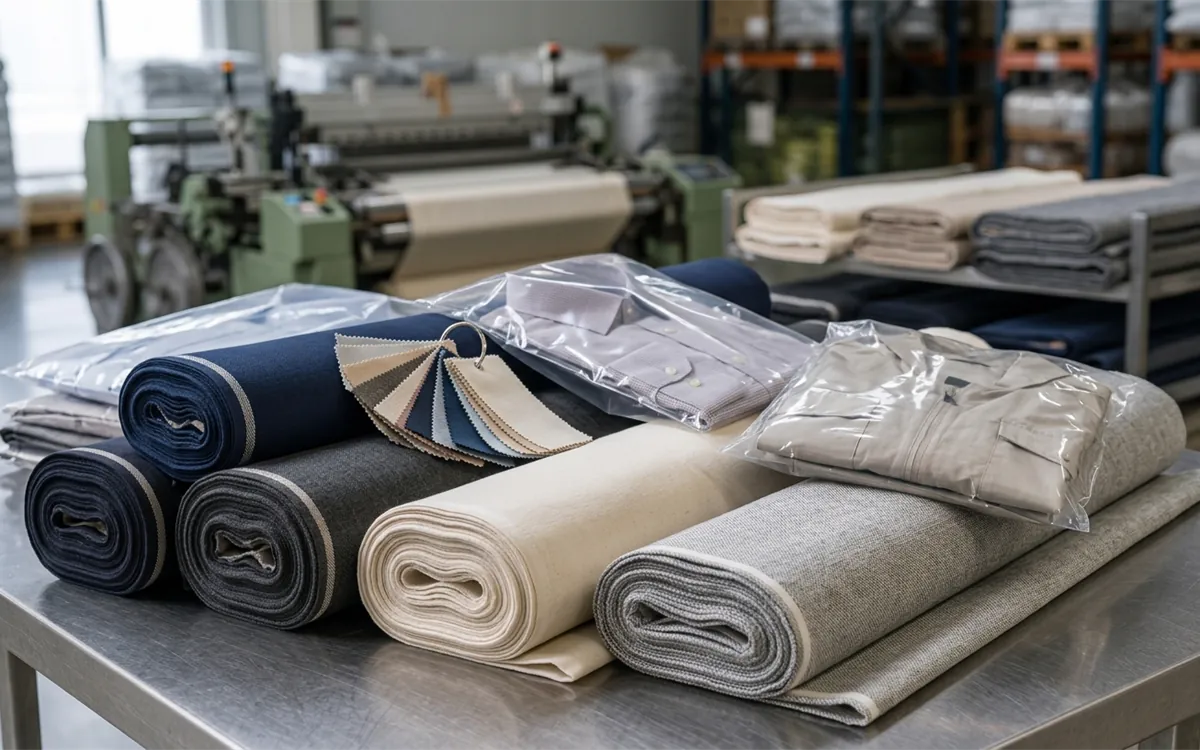
- Documents requiredOEKO-TEX STANDARD 100, social compliance audit (BSCI / SMETA), GOTS for organic
- SamplesProto → fit sample → pre-production sample; colour and measurement approval taken in writing
- Quality controlAcceptable quality level set in the contract; in-line and pre-shipment inspection
- Sourcing geographyDenizli, Bursa, Istanbul, Çorlu, Kahramanmaraş; the Far East and South Asia at high volume
What do we source in the textile group?
In textiles the job is usually not picking from a catalogue but having the product made. The headings below are the areas we work in most often; you can also raise a request for a product that is not listed.
Knitted apparel
T-shirts, sweatshirts, hoodies, polo shirts, tracksuits, leggings, underwear, pyjamas.
Woven apparel
Shirts, trousers, jackets, dresses, skirts, coats, workwear and uniforms.
Baby and children's wear
Bodysuits, rompers, sleepsuits, pyjama sets, children's outerwear, school uniforms.
Home textiles
Duvet cover sets, sheets, pillows and duvets, blankets, coverlets, bedspreads, tablecloths.
Towels and bathrobes
Bath and hand towels, beach towels, hotel and spa bathrobes, kitchen towels, hammam peshtemals.
Curtains and upholstery
Sheer curtains, drapes, blackout curtains, upholstery fabric, awning fabric.
Knitted fabric
Single jersey, rib, interlock, waffle, fleece, combed cotton, brushed two-thread and three-thread fleece.
Woven fabric
Cotton cloth, linen, denim, gabardine, satin, poplin, viscose, blended fabrics.
Technical and industrial textiles
Nonwovens, filter fabric, tent and tarpaulin cloth, geotextiles, sacking fabric.
Socks and accessories
Ankle socks, trainer socks, tights, sports socks; scarves, beanies, gloves, shawls, hats.
Yarn and fibre
Cotton yarn, polyester and acrylic yarn, blended yarn, staple fibre, sewing thread.
Trims and accessories
Zips, buttons, snap fasteners, lining, interlining, woven and printed labels, hangers, polybags.
Which documents are required in the textile trade?
In textiles documentation falls under two headings: product safety and production conditions. Most European buyers ask about the second as well; we establish which your order needs at the request stage.
-
OEKO-TEX STANDARD 100 Certifies harmful substance limits in fabric and trims. Most buyers make it a condition in the baby and children's category.
-
Social compliance audit BSCI, Sedex / SMETA or WRAP. Chain retailers and brands require it from suppliers; we check the validity date of the audit report.
-
Test report Wash and light fastness, shrinkage, grammage, pilling, tensile strength — from an accredited laboratory and matched to the batch number.
-
GOTS and organic cotton Mandatory where an organic claim is made. We additionally verify the certificate's processing scope (which stages from fibre to garment it covers).
-
Labelling and care instructions Fibre composition percentages, care symbols, origin, size and manufacturer details — in the target market's language and compliant with its rules. We check before printing.
-
Origin and movement documents Certificate of origin, A.TR for the EU, EUR.1 for countries with a free trade agreement. Because customs duty rates are high in textiles, this paperwork is a direct cost item.
Typical working terms
The table below shows customary practice in the textile group; the terms applying to each order are set out in the written quotation.
| Packaging | Individual polybag plus carton; PVC bags or boxes for home textiles; hanging garment shipment on request. The carton label states the size and colour breakdown. |
|---|---|
| Loading unit | Carton or palletised loading. Because apparel is bulky, a 40 ft high cube container is common; for fabric and yarn, loading is optimised to roll and pallet dimensions. |
| Delivery terms | EXW, FOB, CFR, CIF and, on request, DAP / DDP. We compare which works out cheaper for you based on the destination port. |
| Samples | Three stages: proto sample, fit and measurement sample, pre-production sample. Series production does not start until the pre-production sample is approved in writing. |
| Lead time | It runs in three stages: fabric supply, dyeing and printing, garment making. For seasonal products fabric supply is the deciding factor; each stage is stated separately in the quotation. |
| Quality control | The acceptable quality level is set in the contract. In-line and pre-shipment inspections are carried out, with an independent inspection company on request. |
Where do we source textiles from?
In textiles the choice of geography is driven by volume: Türkiye for small and medium runs, Asia often better at very high volume. We compare both and show you the result.
Cluster-by-cluster expertise
Textiles in Türkiye are not in one place but split into clusters : Denizli concentrates on towelling and home textiles, Bursa on weaving and upholstery, Istanbul and Çorlu on garment making, Kahramanmaraş and Adana on yarn.
What this means in practice is being able to take your product to the factory that actually specialises in it — not to a general manufacturer.
Short lead times, small runs
Road transport to Europe takes a few days. That makes it possible to repeat orders in season and to test-sell with a small run .
Doing the same from Asia means a six-week sea voyage and much higher minimum quantities. That is where the difference shows in fast fashion and new collection trials.
Certification and auditing
Because many factories already supply Europe, it is not difficult to find manufacturers familiar with OEKO-TEX, GOTS, BSCI and SMETA audits.
If you are selling to chain retailers this is decisive: a manufacturer without an audit report is turned away at the door and starting the process again costs months.
Sourcing from outside Türkiye
On very high volume basics — plain T-shirts, basic underwear, simple home textiles — the unit price is lower in the Far East. In that case we open the search to our global supplier network .
Wherever the source is, your single point of contact does not change: we send the sample, we arrange the inspection, we open the shipment. You talk to us, not to ten separate companies.
Most common questions in textile sourcing
What is your minimum order quantity?
We do not quote a fixed figure; in apparel the minimum is usually set per colour and per size , because the constraint is the fabric, not the garment making. Dyehouses do not accept batches below a certain length, which creates a floor you cannot go under for any one colour.
Working from stock fabric lowers that floor noticeably. If you state your colour and size breakdown in the request, we show in the quotation which option fits your quantity.
Can we have production under our own brand?
Yes — in textiles this is most of what we do. In private label and contract manufacturing, design, patterns, labels, packaging and any custom trims run as separate steps.
If you have a tech pack (size chart, bill of materials, technical drawing) the process is faster; if not, we can reverse-engineer one from a sample garment.
How does the sampling process work?
There are three stages: the proto sample (the overall look of the product), the fit and measurement sample (verifying the size chart), and the pre-production sample (with the fabric, colour and trims that will be used in series production).
Series production does not begin until the pre-production sample is approved in writing. An error that slips through this step affects the whole batch, so we make no exceptions.
How do you keep colour consistent?
Colour is approved from a lab dip and the approved sample is kept as the reference. Assessment is done under a standard light source — metamerism, where a colour looks different under different lighting, is checked separately for this reason.
Small differences between dye lots are unavoidable; the acceptable tolerance is written into the contract. If you do not want lot-to-lot variation in the same product, we plan production in a single dye lot.
Can you find OEKO-TEX or GOTS certified manufacturers?
We can. We do not issue the certificate; independent institutes and accredited bodies do. What we do is restrict supplier selection to facilities holding a valid certificate where your request requires one.
With GOTS we also check the scope : which stages from fibre to garment does the certificate cover? If one link in the chain falls outside it, the organic claim cannot be used on the finished product.
Do you work with buyers who require a social compliance audit?
We do. We match you with manufacturers holding BSCI, Sedex / SMETA and WRAP audits, and check that the report stays valid for the duration of the order.
If your buyer has its own audit protocol, we also run the process of preparing the factory for it; this is normally a step that has to be planned before the order.
Who carries out quality control?
It is done in two stages: an in-line check during production and a final check before shipment. The acceptable quality level is written into the contract, and the inspection is assessed against it.
On request we also arrange it with an independent inspection company, and the report is sent directly to you. Measurements, colour, stitching, trims, labelling and packaging are each checked separately.
Will you source a textile product that is not available in Türkiye?
We do. In textiles this question usually comes down to volume: on basics running into tens of thousands of pieces, the Far East and South Asia can win on unit price. At that point we open the search to our global supplier network .
When the origin changes, the customs duty rate and the required documents change too — in textiles that difference is a serious amount. We show the comparison in writing in the quotation.